By Eamonn Wall, Group Chairman, with 30 years advising businesses across industries.
A recruitment agency can be profitable on paper and still struggle to make payroll.
Temporary workers may need paying every week, while clients take 30, 45 or even 60 days to settle their invoices. That difference can create a funding gap that the agency has to cover throughout the assignment.
A late-paying client doesn’t automatically mean the business is insolvent. But when every payroll depends on money that hasn’t arrived, additional borrowing or another creditor being paid late, directors need to establish whether the problem is temporary or something more serious.
The key question isn’t simply whether the agency has enough work. It’s whether it can afford to keep supplying that work while meeting its financial obligations.
Here we examine what directors should check, when a funding solution may still be realistic and when it’s time to seek insolvency advice.
This article considers the insolvency framework in England and Wales and the employment-business rules applying across Great Britain. Scottish insolvency procedures differ, while Northern Ireland has separate employment and insolvency legislation.
1. Understand where the payroll gap is coming from
Recruitment businesses can generate healthy sales and margins while experiencing serious cash-flow pressure.
The difficulty is often timing. Workers are paid weekly, but the agency may wait several weeks for the client to settle its invoice. Meanwhile, employer costs, pension contributions, PAYE and other overheads continue to fall due.
Directors should start with a rolling cash-flow forecast covering at least the next eight to thirteen weeks.
For each assignment, record:
- The hours worked and whether timesheets have been approved or disputed.
- Worker pay, holiday pay, employer costs and payments due to umbrella companies.
- The amount invoiced, contractual payment date and realistic expected receipt date.
- Any available invoice-finance funding and restrictions on using it.
- Payroll, PAYE, pensions, VAT and other liabilities on their actual payment dates.
The forecast should reflect cash expected to enter and leave the bank, not simply the profit shown in the management accounts.
Don’t include hoped-for receipts or unapproved borrowing as though the money is already available.
If the largest client pays late, how many payrolls can the agency still meet? That answer is often more useful than its reported monthly profit.
2. Approved timesheets matter, but they don’t always remove the obligation to pay
Recruitment businesses need to distinguish between an employment agency and an employment business.
An employment agency generally introduces candidates to employers who then employ and pay them. An employment business supplies temporary workers to hirers and is normally responsible for paying the work-seekers it engages.
Some recruitment companies operate in both ways, so the responsibilities must be checked for each arrangement.
Under Regulation 12 of the Conduct of Employment Agencies and Employment Businesses Regulations 2003, an employment business cannot withhold payment for work done simply because the hirer hasn’t paid.
It also cannot rely solely on the absence of a hirer-approved timesheet where it can establish by other means that the worker performed the work.
That doesn’t prevent the business from investigating a genuine dispute about whether particular work was carried out or the hours claimed are correct. Directors should ensure that attendance records, assignment details and communications are checked promptly.
A missing approved timesheet isn’t, by itself, a reason to withhold payment for work that can be established as completed.
For recruitment businesses, this makes effective timesheet controls essential. Poor records can create both a cash-flow problem and a compliance risk.
3. Check your umbrella-company and PAYE exposure
Where temporary workers are employed through an umbrella company, directors need to understand who is responsible for paying them and operating PAYE.
The rules changed for qualifying payments made on or after 6 April 2026.
The umbrella company remains responsible for operating PAYE. However, the relevant recruitment agency can be jointly and severally liable for qualifying unpaid PAYE amounts. HMRC may therefore seek recovery from the agency if the umbrella company fails to account for the tax correctly.
In a supply chain involving several agencies, the relevant agency will ordinarily be the one contracting directly with the end client. Where no agency is involved, the end client may be liable instead.
More complicated arrangements, particularly those involving overseas intermediaries, require closer examination.
Some arrangements involving personal service companies, managed service companies and workers covered by other employment tax rules fall outside the ordinary umbrella provisions. However, special rules can apply to purported umbrella companies, and off-payroll working legislation may also need consideration.
HMRC explains the changes in its guidance on PAYE rules for labour supply chains involving umbrella companies.
Using an umbrella company doesn’t necessarily remove the recruitment agency’s exposure to unpaid payroll taxes.
Directors should review the actual contracts, payment arrangements and tax responsibilities throughout the supply chain, taking specialist advice where necessary.
4. How a delayed client payment can create a payroll crisis
Consider a recruitment business starting with £30,000 in the bank.
It receives £45,000 from clients in each of the first two weeks, while payroll and other payments total £43,000 per week.
In week three, a major client delays a £35,000 payment. Receipts fall to just £10,000.
The agency still needs to meet its regular payments. In week four, a further £15,000 PAYE liability also falls due.
The result is a £12,000 funding shortfall before the delayed payment is assumed to arrive in week five.
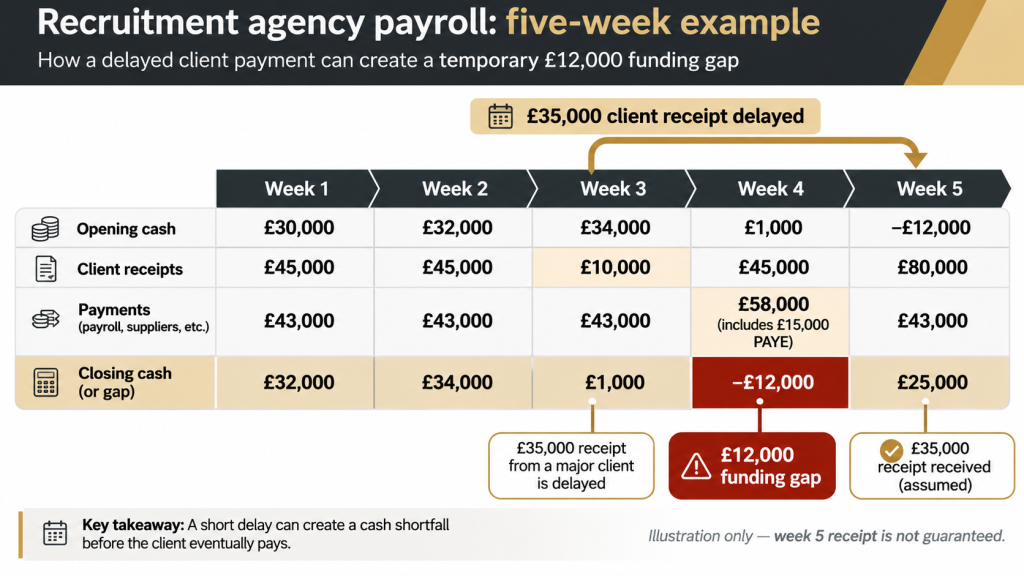
Illustration only. Week four’s payments include an assumed £15,000 PAYE liability due that week. The negative balance represents an unfunded shortfall, not an assumed authorised overdraft. Week five assumes the delayed £35,000 is received; that payment isn’t guaranteed.
The example shows why a business can appear to recover financially while still facing an immediate payment problem.
Money expected in week five cannot be used to meet obligations due in week four unless suitable funding has already been arranged.
If the delayed invoice becomes disputed or the client fails altogether, the situation becomes more serious.
5. Stress-test your largest client
For many recruitment agencies, a relatively small number of clients account for a substantial proportion of weekly receipts.
That concentration creates risk.
Directors should test three scenarios:
- What happens if the largest client pays seven days late?
- What happens if an invoice is disputed for a month?
- What happens if the client becomes insolvent and doesn’t pay?
Each scenario should show the effect on the next payroll, tax liabilities and available funding.
An invoice-finance facility may help bridge some payment delays, but directors shouldn’t assume that every invoice will qualify for an advance.
A funder may restrict funding where timesheets are missing, invoices are disputed, debts are overdue or exposure to a particular client exceeds agreed limits.
The extent of any recourse, reserve, concentration limit, security or personal guarantee depends on the individual agreement.
Even non-recourse arrangements may exclude certain disputed or ineligible debts.
Directors should understand whether the company could be required to repay an advance and whether any personal guarantee could expose them to liability if a client doesn’t pay.
6. When additional funding may still solve the problem
Not every payroll gap is going to require a formal insolvency procedure.
A short-term problem may be manageable where the work has been completed, the invoice is valid, the client is financially sound and the business has a reliable source of funding.
Possible steps include:
- Resolving invoicing errors or missing timesheets.
- Agreeing realistic payment dates with clients.
- Recovering overdue debts.
- Reviewing committed invoice-finance headroom.
- Reducing unnecessary expenditure.
- Negotiating payment arrangements where appropriate.
However, any proposed solution must be tested against the full forecast.
An additional loan might fund this Friday’s payroll, but what happens the following Friday?
If the company needs to borrow more every week simply to maintain existing assignments, the underlying problem may remain unresolved.
A credible funding plan needs to cover the immediate shortfall and leave the business able to meet future payroll, tax and other liabilities.
Directors considering personal funding should also obtain advice on whether the money is being introduced as a loan, equity or another arrangement, particularly where security or guarantees are involved.
7. Recognise when the payroll gap is becoming an insolvency problem
A recruitment business may be approaching insolvency where it finds:
- It cannot meet payroll, PAYE or other debts when they fall due.
- It repeatedly delays one creditor to pay another.
- Forecast receipts keep moving into later weeks.
- More invoices are disputed, overdue or ineligible for finance.
- New assignments create additional payroll commitments that aren’t funded.
- Its main funding facility has reached its limit or is being withdrawn.
- The directors cannot identify a realistic route back to sustainable trading.
Under the Insolvency Act 1986, inability to pay debts as they fall due is one statutory indicator of insolvency. The company’s overall financial position also matters, including its liabilities and prospective obligations.
One missed payroll doesn’t automatically establish that the company is insolvent. But it is a serious warning that needs immediate attention.
When directors know or ought to know that the company is insolvent, bordering on insolvency or facing probable insolvent liquidation or administration, they must give appropriate weight to creditors’ interests.
As the company’s position deteriorates, protecting creditors becomes increasingly important.
This doesn’t necessarily mean trading must stop immediately.
It does mean that directors should reconsider accepting assignments that will create further unpaid worker, tax or supplier liabilities without a credible funding plan.
If the agency cannot fund its existing commitments, taking on more work may make the position worse rather than improve it.
8. What options are available?
The right option depends on whether the business is fundamentally viable and whether it has enough funding to continue trading.
HMRC Time to Pay
Where PAYE or other tax arrears are part of an otherwise manageable problem, directors may be able to request an HMRC Time to Pay arrangement.
This is subject to HMRC’s agreement and an assessment of the company’s circumstances.
PAYE is normally payable by the 22nd of the following tax month when paid electronically, although different deadlines apply to some payment methods and eligible quarterly arrangements.
Time to Pay doesn’t provide cash for worker wages, remove future tax obligations or bind other creditors.
It is therefore unlikely to solve an agency’s problems if the underlying payroll cycle remains unfunded.
Company Voluntary Arrangement (CVA)
A Company Voluntary Arrangement (CVA) may be worth considering where the agency has a viable underlying business but needs to restructure historic debts.
A CVA requires the necessary creditor approval and a realistic plan to fund ongoing trading costs alongside the proposed contributions.
It cannot turn loss-making assignments into profitable work or eliminate the need to pay workers and current liabilities.
Administration
Administration may be relevant where one of the statutory objectives can be achieved, such as rescuing the company as a going concern or producing a better outcome for creditors than liquidation.
However, administration isn’t an automatic source of payroll funding.
A workable proposal needs to consider how any continuing assignments and associated liabilities would be financed.
Creditors’ Voluntary Liquidation (CVL)
Where there is no realistic funding or recovery plan, directors may need to consider an orderly closure through a Creditors’ Voluntary Liquidation (CVL).
A CVL is a formal procedure for winding up an insolvent company, conducted by a licensed insolvency practitioner.
It may be appropriate where continuing to trade would create further losses or expose creditors to additional risk.
The decision should be based on the company’s actual circumstances, not simply one delayed invoice.
9. When should a recruitment agency stop accepting new assignments?
This is often the most difficult decision for directors.
Stopping new work can reduce future income, but continuing to accept assignments without the means to pay workers can increase the company’s liabilities.
Before agreeing to new placements, directors should ask:
- Can we fund the worker payments and employer costs associated with this assignment?
- What happens if the client pays late?
- Will accepting this work worsen the position of existing creditors?
- Is the proposed funding confirmed and available when needed?
- Do we have a realistic plan for the following payrolls?
If the answers reveal an unfunded commitment, the board should urgently reconsider taking on that assignment and seek professional advice.
Where the business has no credible route to meet its liabilities, directors should discuss whether new assignments should be suspended and whether restructuring or closure is appropriate.
Keep records of the forecasts, decisions and advice received.
10. What should directors prepare before seeking advice?
You don’t need perfect accounts before speaking to an insolvency adviser.
What matters is having a realistic picture of the company’s immediate position.
Useful documents include:
- An eight-to-thirteen-week cash-flow forecast.
- The next payroll dates and amounts due.
- PAYE and pension liabilities.
- Aged debtor and creditor reports.
- Timesheet approval and invoice-dispute records.
- Assignment margins and client concentration information.
- Invoice-finance agreements and available facility headroom.
- Security documents and personal guarantees.
- Umbrella-company contracts and details of the labour supply chain.
- Recent bank statements and management accounts.
Most importantly, identify the next date when the business may be unable to meet a payment due.
Frequently asked questions
Can a recruitment agency be insolvent if its clients haven’t paid?
Yes. A recruitment agency can face insolvency even when it has substantial outstanding invoices. The important question is whether the company can pay its debts as they fall due and whether its overall financial position is sustainable. Expected client receipts aren’t the same as cash available to meet payroll.
Does a recruitment agency have to pay temporary workers if the client hasn’t paid?
An employment business generally cannot withhold payment for work done simply because the hirer hasn’t paid or hasn’t approved a timesheet. Regulation 12 of the Conduct Regulations 2003 sets out the relevant restrictions. Genuine disputes about whether work was performed should be investigated using the available evidence.
When should recruitment agency directors seek insolvency advice?
Directors should seek advice promptly if payroll, PAYE or other debts cannot be paid when due, if the business is repeatedly relying on uncertain receipts, or if new assignments would create further unfunded liabilities. Early advice can help establish whether the business has a realistic recovery plan or needs to consider restructuring or closure.
Get advice before the next payroll becomes a crisis
A recruitment agency payroll gap isn’t always an insolvency problem. But repeated shortfalls, disputed invoices and increasing reliance on borrowing can quickly put the business and its creditors at risk.
The earlier directors understand the figures, the more options they may have.
If your recruitment business is struggling to fund payroll, PAYE or other liabilities, Business Rescue Expert can help assess whether the problem is temporary, whether a recovery plan is realistic or whether a formal insolvency procedure needs to be considered.
Call 0333 939 80 40 or contact Business Rescue Expert for a confidential discussion.
This article provides general information rather than advice on a particular company’s legal, tax or financial position. Employment and insolvency obligations depend on the relevant contracts, circumstances and jurisdiction.