Voluntary liquidations also at their highest level for four months
As the economic and political outlook of the world takes an uncertain turn in March, we can look at the latest corporate insolvency figures for February 2026, released by The Insolvency Service this week and see that the direction of travel is already concerning.
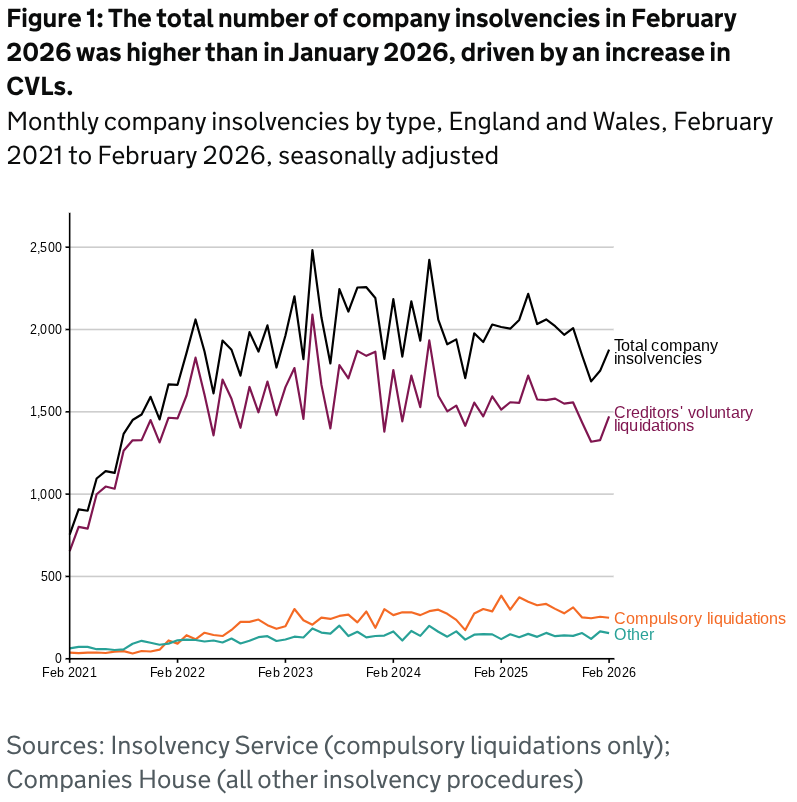
There were a total of 1,878 registered company insolvencies recorded last month in England & Wales, which was 7% higher than then 1,744 recorded last month but 7% lower than the same month last year (2,015).
It’s very early in this reporting cycle but already the monthly numbers of company insolvencies at the end of 2025 and the start of 2026 were lower than the levels typically seen between 2022 and 2025.
Analysis
Creditors Voluntary Liquidations (CVLs)
Of the 1,878 corporate insolvencies in February, the most frequent kind remains Creditors’ Voluntary Liquidations (CVLs) with 1,473 – this is 11% higher than last month’s total but 3% lower than the same month a year ago.
CVLs accounted for 78% of all company insolvencies last month, 2% higher than in January.
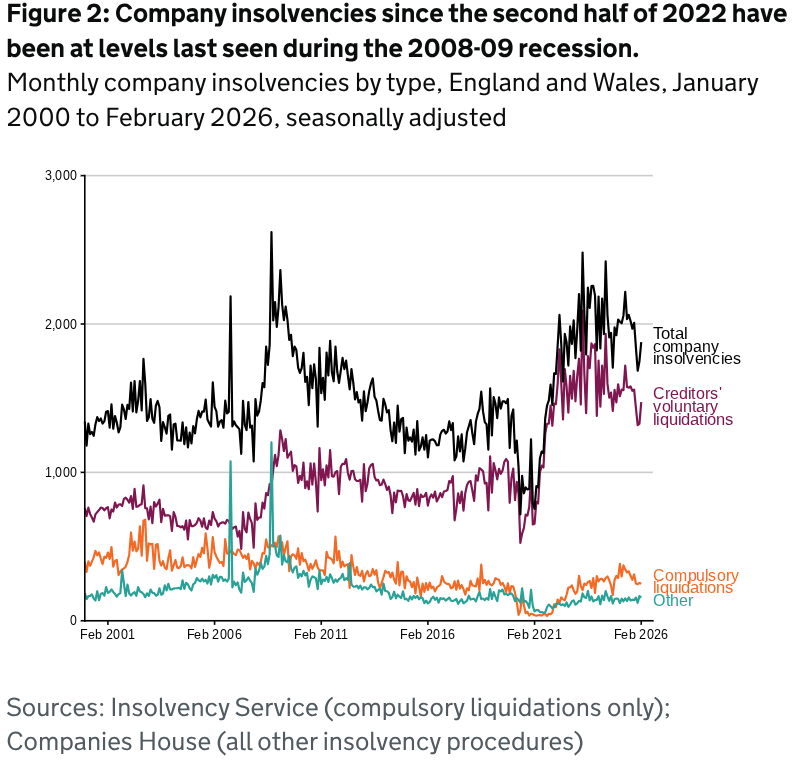
The average number of CVLs over the last four months is 10% lower than the average numbers from 2025. In 2025 as a whole, CVL volumes slightly decreased by 2% from 2024 and were down by 10% on the record highs seen in 2023.
Between 2017 and 2019, CVLs had been rising at approximately 10% a year but during the pandemic they fell to their lowest levels since 2007.
Compulsory Liquidations
There were 249 compulsory liquidations in February 2026 which was 2% lower than last month’s total and 35% lower than February 2025. This total is also 20% lower than the 2025 monthly average.
Compulsory liquidations saw their highest levels since 2012 last year, rising annually by 15%. This is a precipitous increase from their historically low levels in 2020 and 2021 when restrictions were applied by the government on the use of statutory demands and winding-up petitions.
HMRC will continue to target companies that owe outstanding Corporation Tax, VAT, PAYE or National Insurance Contributions (NICs) arrears this year. More agents are being recruited, more funding has been allocated and they will use it to retrieve as much as possible from debtors.
Administrations
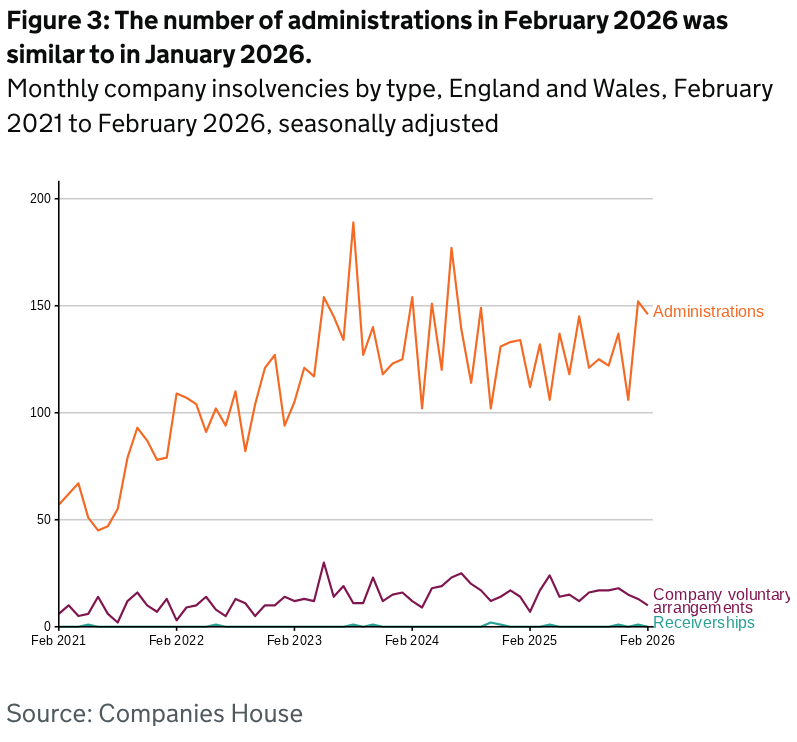
There were 146 administrations in February which was 4% lower than the previous monthly total. It was, however, 30% higher than in a year ago and 17% higher than the 2025 monthly average.
In 2025 as a whole, the number of administrations decreased by 8% annually following a sustained increase between 2022 and 2024 after an 18-year annual low seen during the pandemic in 2021.
Company Voluntary Arrangements (CVAs)
There were 10 Company Voluntary Arrangements (CVAs) in February which was down 23% on last month but 43% higher than in February 2025. These figures remain low compared to their historical levels.
CVAs were lower in 2025 than in 2024 but broadly in line with 2023. Overall the number of CVAs last year was 47% lower than the annual average from 2015 to 2019.
There were no receivership appointments in February and while there was one last month, they are relatively rare with only three being registered in the whole of 2025.
There was one moratorium registered at Companies House in February and no restructuring plans. Between June 26th 2020 and February 28th 2026, 68 companies obtained a moratorium and 57 companies had a restructuring plan registered at Companies House. Both procedures were created by the Corporate Insolvency and Governance Act 2020.
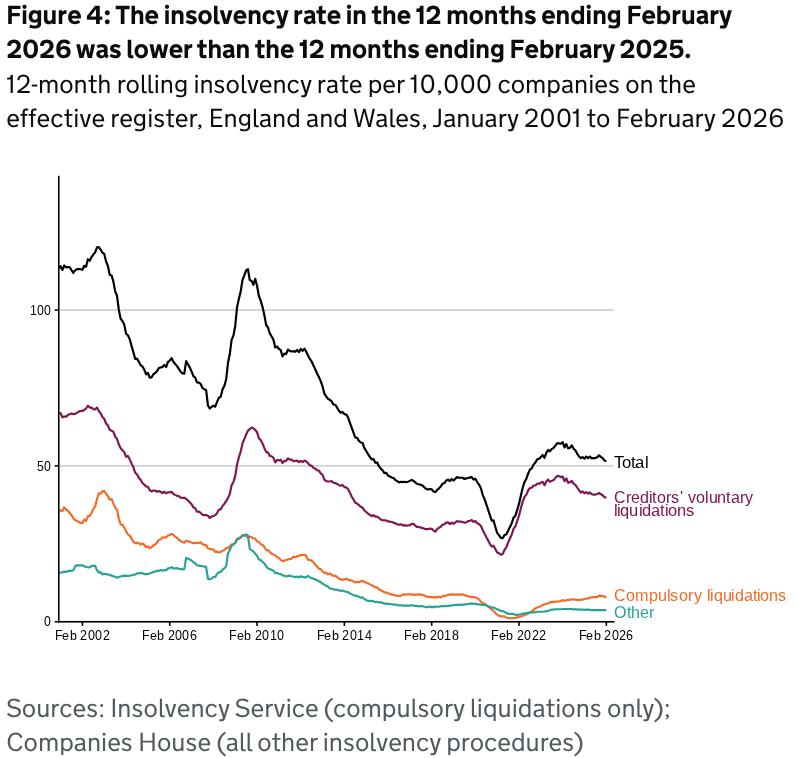
The rolling company liquidation rate in the 12 months to February 2026 was 51.5 per 10,000 companies on the effective register in England and Wales which corresponds to one in 194 companies entering insolvency.
This is a slight increase on last month which saw 51.7 per 10,000 companies or one in 193.
The rolling rates are calculated as a proportion of the total number of companies on the effective register and are more comparable over longer time periods than the absolute numbers. A 12-month rolling rate is presented to reduce the volatility associated with estimates based on single months.
Scotland
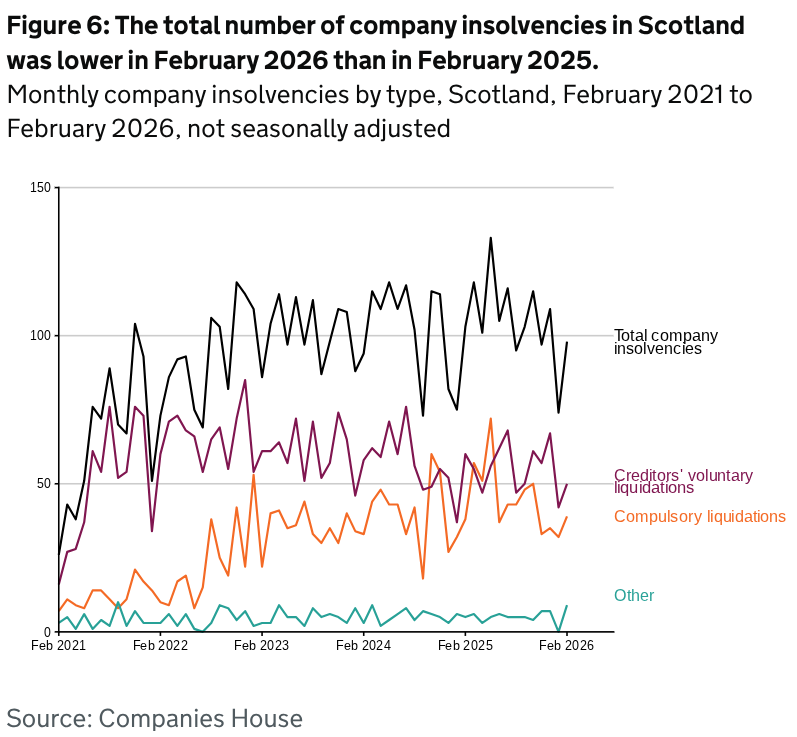
In February there were 98 company insolvencies registered in Scotland which was 24 higher than last month but 5% lower than a year previously.
The total number of company insolvencies was comprised of 50 CVLs (up from 42); 39 compulsory liquidations (up from 32); six administrations (up from zero); two receivership appointments (up from zero) and one CVA (up from zero).
It’s important to note that Scotland’s insolvency regime is partly devolved.
The Accountant in Bankruptcy (AiB) is Scotland’s insolvency service and administers the Register of Insolvencies which is a publicly accessible statutory register regarding the insolvency of individuals and businesses in Scotland including company liquidations and receiverships.
Between June 26th 2020 and February 28th 2026, there were three restructuring plans and two moratoriums in Scotland.
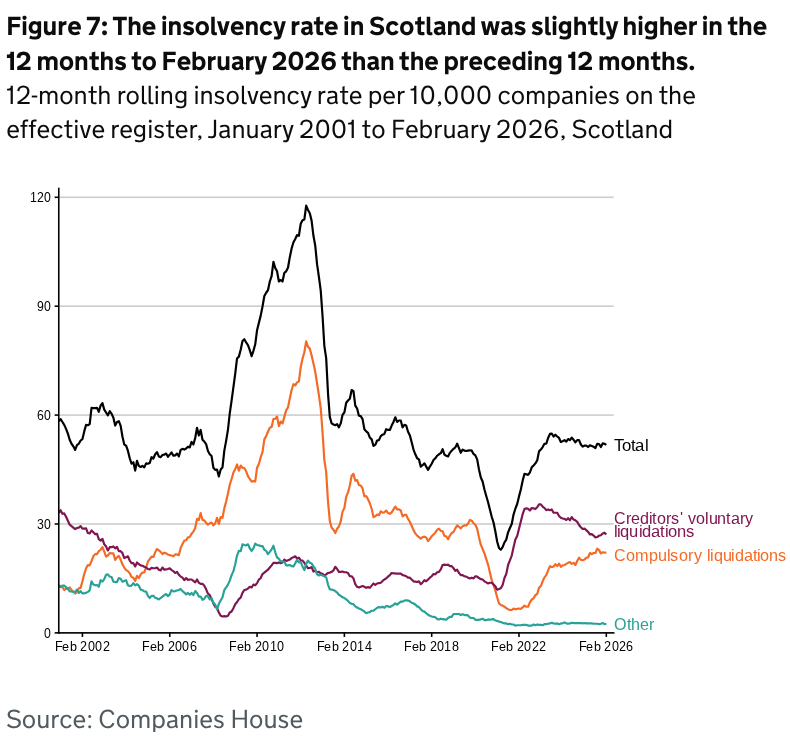
Scotland has always traditionally recorded more compulsory liquidations than any other kind of insolvency procedure but CVLs overtook them in April 2020 and typically remained higher until a three month period from March to June in 2025, when they retook the higher position.
The total insolvency rate in Scotland in the 12 months to February 2026 was 51.8 per 10,000 companies on the effective register. This was up by 0.2 from the preceding 12 months ending in February 2025.
Northern Ireland
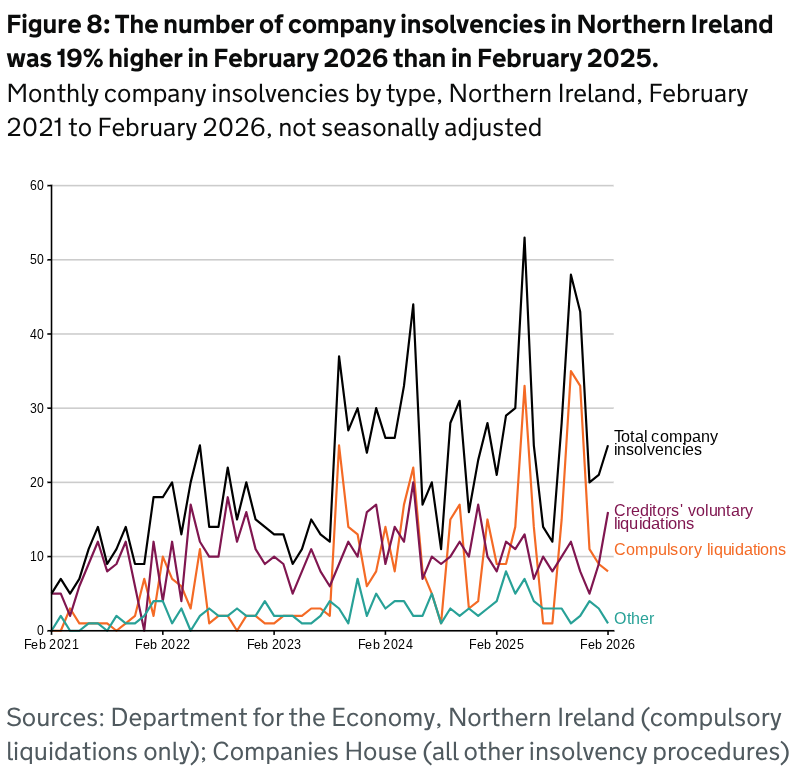
In February there were 25 company insolvencies registered in Northern Ireland, which was four higher than last month and 19% higher than the same month a year previously.
The total number of company insolvencies in the province was comprised of eight compulsory liquidations (down one); 16 CVLs (up from nine) and one administration (down from two). There were no CVAs (down from one) and no receivership appointments.
Between June 26th 2020 and February 28th 2026, there was one moratorium in Northern Ireland and no restructuring plans.
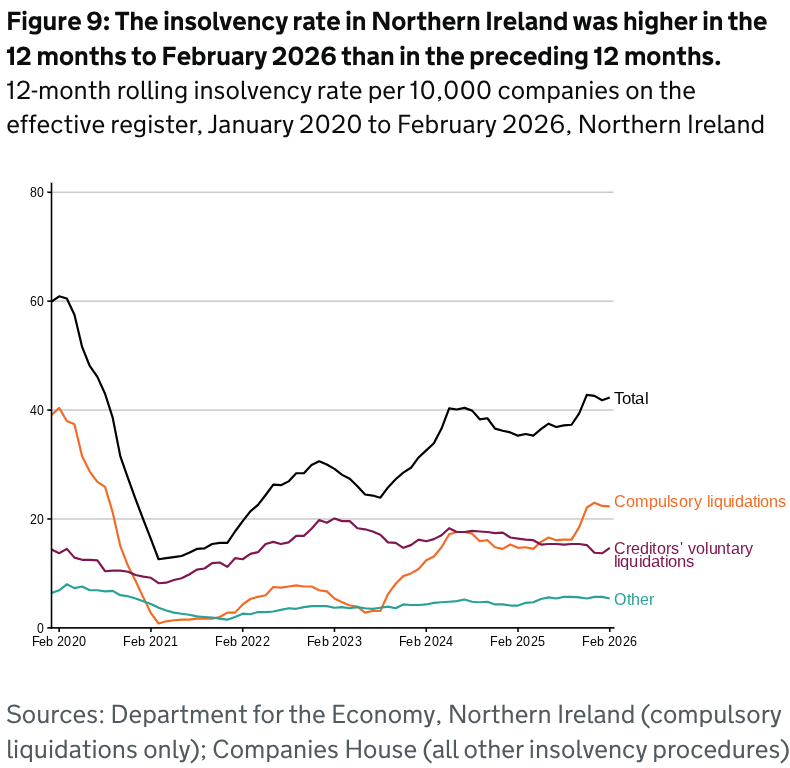
The total insolvency rate in the 12 months to February 2026 in Northern Ireland was 42.3 per 10,000 companies on the effective register. This is an increase of 0.5 from a month ago and an increase of 7.0 from the 12 months to February 2025.
The total number of company insolvencies for the whole of the UK in February 2026 was 2,001 – a month-on-month increase of 162.
Tom Russell, president of R3, the UK’s restructuring, turnaround and insolvency trade body, said: “While February’s figures pre-date the current Middle East conflict, the rise in energy and fuel prices we’re now seeing will inevitably mean a very shaky start to the quarter for many companies.
“Despite economic activity stalling in January, there had been some signs of stability returning to the economy, but the situation in the Middle East has delivered a fresh shock to businesses and households.
“The fallout from his geopolitical uncertainty risks hitting consumer spending, business confidence and investment decisions and reduces the likelihood of interest rates coming down when the Bank of England makes their decision later this week.
“Sectors with high energy usage or thin margins, including hospitality such as hotels and restaurants may be particularly exposed and could feature more prominently in the insolvency figures as the year progresses.
“We’re already seeing business owners becoming more cautious about investment decisions, choosing to wait and see rather than commit while costs and demand remain uncertain. That hesitation, combined with rising overheads, means some businesses that were just about coping may now find themselves under renewed strain.
“This is likely to have a knock-on effect on insolvency rates in the coming months as higher costs make their way through to supply chains and balance sheets.”
The events of the first months of 2026 show us that nothing can be taken for granted and that circumstances can change very quickly.
This is worth keeping in mind if your business hasn’t made the progress you wanted this year. There is still more than enough time to make the decisions and changes necessary to get to where you want to be – personally and professionally.
Get in touch with us for a free initial consultation about the options you could have to help you create and work through a feasible plan and strategy no matter what your short and medium term goals for the year.
We’ll help you to implement them – the sooner you get in touch, the sooner we can begin.